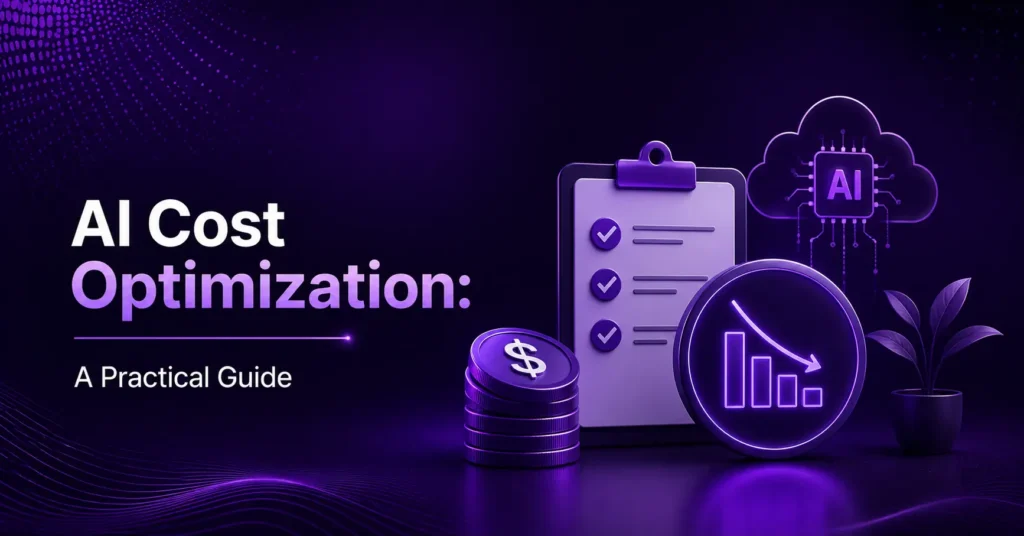
TL;DR: AI cost optimization is the practice of reducing what you spend on AI systems—including LLMs, Microsoft Copilot, Azure OpenAI, AI agents, and GPU infrastructure—without cutting the business value those tools deliver.
It combines smarter model selection, usage governance, license management, and FinOps disciplines to keep AI spending aligned with real outcomes.
Enterprise AI budgets are growing fast. According to Gartner, global AI software spending is projected to reach $297 billion by 2027. Yet most organizations can’t answer three basic questions: Which AI tools are actually delivering value? Which teams are consuming the most budget? And why did costs double last quarter?
That’s the real problem. Companies are investing heavily in tools like Microsoft 365 Copilot, Azure OpenAI, ChatGPT Enterprise, and AI agents—but few have the visibility or governance to control what they spend.
This guide covers exactly that. You’ll learn what drives AI costs up, which expenses stay hidden, and 15 proven strategies to reduce spend without slowing your team down.
What Is AI Cost Optimization?
AI cost optimization means managing and reducing the total cost of your AI systems while keeping—or improving—the business results they produce.
It’s broader than cutting cloud bills. It covers:
- LLM API usage (tokens consumed per request)
- Microsoft Copilot licensing (seats assigned vs. seats used)
- AI agent workflows (each agent step can trigger multiple model calls)
- GPU and compute infrastructure
- Shadow AI (tools employees buy without IT approval)
- Failed pilots and low adoption
Why do AI costs keep increasing?
A few reasons compound quickly:
- More users get access to AI tools
- AI agents trigger multiple model calls per request
- Context windows grow larger and cost more per call
- Multi-model workflows stack costs across providers
- No one owns the budget or monitors usage
The shift from simple chatbots to multi-agent workflows is where costs tend to spike. One user request can trigger a chain of agent actions—each one billed separately.
Understanding Enterprise AI Costs
LLM API costs
Every time your system calls an LLM—GPT-4o, Claude 3.5, Gemini 1.5, or Azure OpenAI—you pay per token. Tokens are small chunks of text. A single page of content uses roughly 500–750 tokens. Complex prompts with long context windows can cost 10–20x more than simple ones.
Microsoft Copilot licensing
Microsoft offers several Copilot products at different price points:
| Product | Primary Use | Cost Driver |
|---|---|---|
| Microsoft 365 Copilot | Word, Excel, Outlook, Teams | Per-user monthly license |
| Copilot Chat | General AI chat | Usage-based |
| Copilot Studio | Build custom AI agents | Credits per message/trigger |
| Security Copilot | Threat analysis | Compute units |
A common trap: organizations buy Microsoft 365 Copilot licenses at $30/user/month and leave 30–40% of seats unused within 90 days. That’s a significant budget drain with zero return.
Hidden AI costs
This is what most organizations miss:
- Unused licenses — seats assigned to employees who rarely log in
- Duplicate tools — teams buying separate AI subscriptions for the same job
- Prompt inefficiency — poorly written prompts that consume more tokens than needed
- Agent loops — AI agents that retry failed tasks repeatedly, multiplying costs
- Failed pilots — proof-of-concept projects that never reach production but still accumulate bills
- Governance overhead — time spent manually tracking usage without proper tooling
Why AI Cost Optimization Matters
Here’s the business case, plainly stated:
- Financial: Unmanaged AI spend scales with usage. Without controls, budgets break at scale.
- Governance: No visibility means no accountability. Teams overspend without realizing it.
- Security: Shadow AI creates compliance and data risks.
- Scalability: You can’t scale what you can’t measure.
The 15 Best AI Cost Optimization Strategies
1. Build an AI strategy before buying AI tools
Most organizations optimize after they’ve already overspent. Starting with a clear strategy—defining which use cases justify which tools—prevents that entirely. Map business outcomes to AI investments before signing contracts.
2. Right-size your AI models
Not every task needs a frontier model. Use a tiered approach:
- Small models (e.g., GPT-4o mini): FAQs, classification, simple summarization
- Mid-tier models: Document analysis, drafting, structured data tasks
- Frontier models (e.g., GPT-4o, Claude 3.5 Sonnet): Complex reasoning, legal review, multi-step analysis
Intelligent model routing—automatically sending tasks to the cheapest model that can handle them—is one of the highest-impact strategies available.
3. Optimize prompt engineering
Shorter, clearer prompts cost less and often produce better outputs. Remove unnecessary context. Use structured formats. Avoid sending full documents when only a section is relevant.
4. Optimize Microsoft Copilot licenses
Run a license audit every quarter. Check:
- Which users haven’t logged into Copilot in 30+ days
- Which departments have the lowest adoption rates
- Whether Copilot Chat (free tier) covers use cases you’re paying Copilot M365 licenses for
Reallocate unused licenses before renewing.
5. Optimize AI agent workflows
AI agents are powerful—and expensive. Each step in an agent workflow can trigger a separate model call. To control costs:
- Set execution limits on agent loops
- Add loop-prevention logic
- Monitor tool call frequency
- Use lightweight models for agent orchestration steps
6. Implement semantic caching
Semantic caching stores AI responses to common queries. When a similar question comes in, the system returns the cached answer instead of calling the LLM again. This cuts inference costs and reduces response time.
7. Set token budgets
Assign token limits by department, team, project, or user. Gateway-enforced token budgets stop overspending before requests are executed—not after the bill arrives.
8. Deploy AI FinOps practices
AI FinOps applies financial operations discipline to AI spending. Key practices include:
- Showback: Show teams how much AI they consume
- Chargeback: Bill departments for their actual AI usage
- Forecasting: Model future spend based on usage trends
- Budget ownership: Assign a named owner to each AI cost center
9. Monitor usage continuously
You can’t manage what you don’t measure. Build dashboards that track:
- Token consumption by model, team, and use case
- License utilization rates
- Cost per AI-assisted task
- Anomaly alerts for unexpected spend spikes
10. Consolidate AI vendors
Multiple overlapping tools means duplicate costs. Audit your AI tool inventory. Identify where two tools serve the same purpose. Consolidate where possible, especially within the Microsoft ecosystem if you’re already paying for M365.
AI Cost Optimization by Department
| Department | AI Opportunity | Key Optimization |
|---|---|---|
| HR | Employee onboarding, policy Q&A | License optimization, Copilot Chat |
| Finance | Reporting, forecasting | Workflow automation, model routing |
| Sales | Proposal generation | Smaller models for drafts |
| Marketing | Content creation | Prompt optimization, caching |
| Customer Support | AI agents, ticketing | Semantic caching, loop limits |
| IT | Helpdesk automation | Governance policies, token budgets |
How to Measure AI ROI
ROI formula:
AI ROI = (Value Delivered − Total AI Cost) ÷ Total AI Cost × 100
Track these KPIs:
- Time saved per user per week
- Cost per AI-assisted task vs. manual equivalent
- Adoption rate (active users ÷ licensed users)
- Error reduction in AI-assisted workflows
- Revenue influenced by AI-generated content or decisions
Microsoft’s own data suggests that at $30/user/month for Copilot M365, the investment breaks even if each employee saves roughly 15 minutes per working day. For most knowledge workers, that’s achievable—but only with proper adoption support.
Common AI Cost Optimization Mistakes
- Buying premium frontier models for every task, regardless of complexity
- No visibility into who is using what, or how much
- Ignoring unused Copilot licenses month after month
- Setting no token limits until a surprise bill arrives
- Running AI pilots with no governance and no exit criteria
- Optimizing infrastructure costs while ignoring user behavior
AI Cost Optimization Checklist
Use this before your next AI budget review:
- AI tool inventory completed
- Licenses audited and reallocated
- Token budgets established by team
- Model routing rules implemented
- Governance policies documented
- Cost dashboards deployed
- Department cost owners assigned
- ROI metrics tracked
- Quarterly optimization reviews scheduled
Start Reducing AI Costs Now
AI cost optimization is not just about cutting cloud bills. The organizations that do it well combine strategy, governance, smart model selection, Microsoft ecosystem management, and adoption tracking into a continuous practice.
The result: they spend less on AI than their peers—and get more from it.
Ready to find out where your AI budget is leaking?
Book an AI Cost Optimization Assessment with Copilot Experts. We’ll analyze your Microsoft Copilot, Azure OpenAI, AI agents, and enterprise AI workloads, then give you a clear action plan to cut waste and improve ROI.
Book a free AI Cost Optimization Call
Frequently Asked Questions
What is AI cost optimization?
AI cost optimization is the process of reducing what you spend on AI tools—LLMs, Copilot licenses, agents, and infrastructure—while maintaining or improving the business value those tools produce.
Why are enterprise AI costs increasing?
Costs rise as organizations add users, deploy AI agents, and shift to more complex multi-model workflows. Each agent step can trigger multiple model calls. Without governance, spend compounds quickly.
How can Microsoft Copilot costs be reduced?
Run quarterly license audits, monitor adoption by department, reallocate unused seats, and evaluate whether Copilot Chat covers lower-intensity use cases before assigning paid M365 Copilot licenses.
What is AI FinOps?
AI FinOps applies financial operations principles—chargeback, showback, forecasting, and budget ownership—to AI spending. It gives organizations cost visibility and accountability across teams.
What is semantic caching?
Semantic caching stores AI responses to common queries. When a similar request arrives, the system serves the cached response instead of calling the LLM again, cutting both cost and latency.
Which AI model is most cost-effective?
It depends on the task. GPT-4o mini and similar small models handle simple tasks at a fraction of the cost of frontier models. Use frontier models only when the complexity genuinely requires them.
How do AI agents increase costs?
Each step in an agent workflow—retrieving data, calling a tool, generating a response—can trigger a separate model call. A single user request can generate five to ten billable actions without the right controls.
How do you measure AI ROI?
Track time saved, cost per task, adoption rates, and business outcomes tied to AI use. Compare against the total cost of licenses, compute, and operations.
Should companies hire an AI cost optimization consultant?
If your organization is spending over $50K/year on AI tools with no governance framework, yes. An external assessment often identifies 20–40% in recoverable waste within the first 90 days.
Stop Paying for AI You’re Not Using
AI cost optimization isn’t a one-time project. The most successful organizations combine clear AI strategy, usage governance, intelligent model routing, FinOps practices, and continuous adoption management to get real value from every dollar spent.
The goal isn’t to spend less on AI. It’s to spend better.
Ready to find out where your AI budget is going?
Book an AI Cost Optimization Assessment with Copilot Experts. We’ll analyze your Microsoft Copilot, Azure OpenAI, AI agents, and enterprise AI workloads—and give you a clear plan to cut unnecessary spend, improve adoption, and measure real ROI.
