

Microsoft Copilot has moved from experiment to standard business tool. More organizations are buying AI assistants to save time, cut manual work, and stay competitive. Copilot sits at the centre of that shift, built into Microsoft 365, Windows, GitHub, Security, and the Power Platform.
But here’s the challenge. Decision-makers need reliable data before committing to licences and rollout plans, and the numbers are scattered across vendor reports, government trials, and independent analysts. This article pulls the most credible figures into one place — covering adoption, productivity, ROI, market growth, and where Copilot is heading next.
One note before you read on. AI adoption data changes fast. Treat these figures as a snapshot of early 2026 and review them regularly before making big decisions.
Microsoft Copilot statistics: quick highlights
Here are the key verified statistics worth knowing.
- More than 20 million paid Microsoft Copilot seats are now in use (Panto AI, 2026).
- More than 90% of the Fortune 500 use Microsoft Copilot.
- Over 450 million commercial Microsoft 365 seats provide the install base Copilot sells into.
- 70% of early users said Copilot made them more productive; 68% said it improved work quality.
- A UK government trial found users saved 26 minutes a day on average.
- Forrester’s commissioned study estimated a 116% ROI and 9 hours saved per user per month.
- 49% of Copilot conversations support cognitive work like analysis and problem-solving.
- Active agents in the Microsoft 365 ecosystem grew 15x year over year (Microsoft Work Trend Index, 2026).
- Gartner forecasts worldwide AI spending of $2.52 trillion in 2026, up 44% year over year (Panto AI, 2026).
- McKinsey found 88% of organizations use AI in at least one business function.
Microsoft Copilot at a glance
Microsoft Copilot is an AI assistant built directly into tools your teams already use. It drafts content, analyses data, summarises documents, and answers questions inside Windows and Microsoft 365 apps.
The Copilot name covers several products. Here’s how they fit together:
- Microsoft 365 Copilot: AI inside Word, Excel, Outlook, PowerPoint, and Teams.
- GitHub Copilot: AI coding assistance for developers.
- Microsoft Copilot Studio: A platform for building and managing custom AI agents.
Because Copilot works inside familiar apps, your people don’t need to change how they work. That’s a large part of why adoption has scaled so quickly.
Microsoft Copilot adoption statistics
Enterprise adoption
Enterprise is where Copilot’s scale shows clearest. More than 90% of the Fortune 500 now use it. That kind of penetration among large firms is rare for a product barely two years old.
The rollouts are big, too. Barclays expanded from 15,000 to 100,000 employees, and Infosys, TCS, and Wipro each scaled past 100,000 seats — combining for over 300,000 in under six months. Microsoft also reported a 4x year-on-year increase in customers with more than 50,000 seats.
Why it matters: Large enterprises rarely commit at this scale without measurable results behind closed doors.
Small and medium business adoption
Copilot opened to businesses of all sizes in early 2024, removing the old seat minimum. That change matters for you if you run a smaller team.
SMBs tend to adopt for the same everyday tasks: drafting emails, summarising meetings, and pulling insights from spreadsheets. The barrier to entry is low because Copilot Chat is included at no extra cost for eligible Microsoft 365 users.
Business insight: Smaller firms often move faster than large ones. Fewer approval layers mean a team can test Copilot, see results, and expand within weeks rather than quarters.
Industry-wise adoption
Microsoft doesn’t publish numeric usage by sector, but its scenario libraries show where Copilot is actively deployed (SeoProfy, 2026).
- Manufacturing: Operations, product design, and resource planning.
- Retail: Merchandising analysis and inventory forecasting.
- Financial services: Reporting and analysis, with strong Frontier Professional concentration.
- Healthcare: Documentation and administrative support.
- Information technology: Helpdesk workflows and internal reporting.
- Professional services: Proposal writing and client deliverables.
- Government: Tested at scale in the UK cross-government trial of 14,500 users.
Regional adoption
Copilot is generally available worldwide. Web traffic shows where interest concentrates: the United States leads with 22.73% of visits, followed by India, Brazil, the UK, and Japan.
Asia is the fastest-moving enterprise market right now, driven by the large Indian IT firms. North America leads in maturity, while Europe shows steady, governance-conscious uptake.
Microsoft Copilot productivity statistics
Time savings
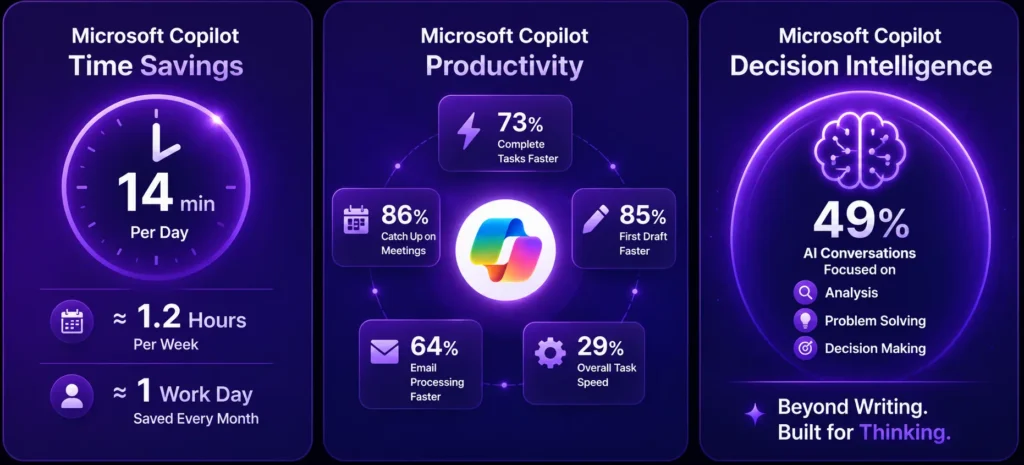
Microsoft’s early-user study found average savings of 14 minutes per day, or 1.2 hours per week. The UK government trial reported a larger figure: 26 minutes a day, with 83% adoption at peak.
What that means in practice: even the conservative number frees up roughly a full working day each month per employee.
Employee productivity
The qualitative results are strong. In Microsoft’s research, 73% of users said they completed tasks faster, and 85% said Copilot helped them reach a good first draft sooner.
Meetings and email show the clearest gains. 86% found it easier to catch up on missed meetings, 84% acted on meetings more effectively, and 64% processed email more efficiently. In task-based tests, Copilot users were 29% faster overall.
Decision-making
Nearly half of Copilot use now supports thinking work, not just output. 49% of conversations involve analysis, problem-solving, and evaluation.
That points to a shift. Copilot is becoming a research and reasoning partner, not just a faster way to write.
Microsoft Copilot ROI statistics
The strongest published economics come from Forrester’s commissioned Total Economic Impact study. For a composite organization of 25,000 employees, it estimated a 116% ROI and $19.7 million net present value.
- Productivity ROI: 9 hours saved per user per month.
- Cost savings: A 0.24% decrease in expenditures.
- Faster delivery: A 2.6% increase in topline revenue.
- Reduced admin: A 25% reduction in onboarding time.
Business takeaway: ROI here depends on usage, not licences. The figures reflect organizations that drove adoption — not ones that bought seats and walked away.
Microsoft Copilot usage statistics
Usage is concentrated in the apps your teams already live in. Daily adoption is highest in Teams (34%), followed by Outlook (33%) and Word (25%).
- Teams: Up to 71% maximum adoption.
- Outlook: 33% daily use.
- Word: 25% daily, 43% weekly.
- Excel: 23% top adoption.
- PowerPoint: 24% top adoption.
Excel and PowerPoint lag behind the communication tools. Spreadsheet and slide tasks are more complex, so they take longer to embed into daily habits.
Microsoft Copilot statistics by department
Function-specific results show where value lands fastest.
- Sales: Among 133 sales users surveyed, the average time saved was 90 minutes per week, and 83% said Copilot for Sales made them more productive.
- HR: Onboarding time fell 25% in Forrester’s analysis, and HR teams use Copilot for policy drafting and self-service queries.
- Marketing: Content creation, campaign planning, and AI-assisted writing are common entry points.
- Finance: Reporting, forecasting, and analysis drive adoption.
- IT: Helpdesk automation and knowledge management lead use.
Microsoft Copilot AI agent statistics
Agents are Microsoft’s biggest current focus. The number of active agents in the Microsoft 365 ecosystem grew 15x year over year — rising to 18x in large enterprises.
The shift is qualitative as well as numerical. Before 2025, most agents were experimental and manually triggered. Now they own multi-step workflows end-to-end.
Copilot Studio sits behind much of this. It lets your team describe an agent in plain language, choose from multiple AI models, and apply governance controls — without writing code for every step.
Microsoft Copilot market statistics
Copilot sits inside a large spending cycle. Gartner forecasts worldwide AI spending of $2.52 trillion in 2026, up 44% year over year, with generative AI model spending growing 80.8%.
The AI agent market alone is projected to reach $11.5 billion in 2026, up from $7.8 billion in 2025. Microsoft’s advantage is distribution: over 450 million commercial seats give it a channel that standalone assistants cannot match.
First call is free.
Microsoft Copilot vs other AI tools
Each tool plays a different role. Copilot competes as a workflow layer, not a standalone chatbot.
| Metric | Microsoft Copilot | ChatGPT | Gemini |
|---|---|---|---|
| Active users | ~33M all surfaces | ~800M weekly | 350–650M monthly |
| Enterprise seats | 20M+ paid | 7M+ (ChatGPT for Work) | Bundled with Workspace |
| Core strength | Microsoft 365 integration | General-purpose chat | Google ecosystem |
| Typical business use | Productivity in Office apps | Drafting, research | Docs, Gmail, search |
Sources: SeoProfy, 2026 and Panto AI, 2026.
Lean More: Microsoft Copilot vs ChatGPT for Business
ChatGPT leads on raw user numbers. Copilot leads on enterprise integration. They aren’t a clean head-to-head.
Microsoft Work Trend Index insights (2026)
Microsoft surveyed 20,000 workers across 10 countries for its 2026 report. A few findings stand out.
- 66% of AI users say AI lets them spend more time on high-value work.
- 58% say they’re producing work they couldn’t have a year ago.
- 86% treat AI output as a starting point, not a final answer.
Here’s the insight that should shape your strategy. Organizational factors — culture, manager support, talent practices — account for more than twice the AI impact of individual effort alone. Tools alone don’t deliver results. The system around them does.
Microsoft Copilot business trends in 2026
A few clear trends are emerging:
- AI agents are moving from pilots into production workflows.
- Autonomous workflows that advance work and escalate to humans only when judgment is needed.
- Intelligent knowledge search across internal documents and systems.
- AI-powered decision-making as cognitive tasks dominate usage.
Microsoft Copilot predictions beyond 2026
These are outlooks, not facts — treat them as direction rather than certainty.
- Multi-agent systems that coordinate specialized agents toward one outcome.
- Deeper Microsoft 365 integration as Copilot becomes a default layer.
- Voice AI for hands-free, conversational work.
- Industry-specific copilots tuned to regulated sectors.
IDC projects roughly 1.3 billion AI agents in operation by 2028. Even if that number proves optimistic, the direction is clear.
Key takeaways from Microsoft Copilot statistics
- Adoption is accelerating, with 20 million+ paid seats and 90% of the Fortune 500 on board.
- Productivity gains are measurable — 14 to 26 minutes saved per user per day.
- AI agents are going mainstream, growing 15x year over year.
- ROI depends on implementation, not licence count.
- Strategy matters most: organizational readiness drives twice the impact of individual effort.
Why businesses choose Copilot Experts
Buying licences is the easy part. Getting value from them is where most organizations struggle.
Copilot Experts helps you move from experimentation to successful, measurable adoption. We focus on the factors the data shows actually matter — governance, training, and business alignment.
Our services:
- Microsoft Copilot consulting: Strategy built around your goals.
- Copilot readiness assessment: Know where you stand before you spend.
- Microsoft 365 optimization: Prepare your environment for AI.
- AI agent development: Build agents that own real workflows.
- Copilot Studio consulting: Design and govern custom agents.
- User training: Drive the adoption that drives ROI.
- Governance and adoption: Scale safely without losing control.
Why choose us: We’re Microsoft ecosystem specialists with an ROI-focused approach and end-to-end consulting from assessment to rollout.
The bottom line on Copilot in 2026
Microsoft Copilot adoption keeps climbing, and the productivity benefits are well-documented across vendor studies, government trials, and independent ROI analysis. The evidence is strong for organizations that plan properly.
But here’s what the data really shows. Success depends on governance, training, and business alignment — not on buying licences. Use current figures to guide your investment, then build the strategy that turns those seats into results.
Book a free consultation and find out how your organization can start realizing productivity gains — without the guesswork.
Frequently asked questions
How many people use Microsoft Copilot?
Microsoft has disclosed more than 20 million paid Copilot seats, with third-party estimates of around 33 million active users across all surfaces.
Is Microsoft Copilot growing?
Yes. Paid seats passed 20 million, and Microsoft reported a 4x year-on-year increase in customers with more than 50,000 seats.
How many businesses use Microsoft Copilot?
More than 90% of the Fortune 500 use it, alongside a broad base of small and medium businesses.
Does Microsoft publish Copilot usage data?
Not as a single unified metric. Microsoft shares milestones and studies, while analysts combine telemetry, traffic, and survey data to estimate adoption.
Which industries use Microsoft Copilot the most?
Documented use spans manufacturing, retail, financial services, IT, and professional services.
What is Microsoft’s Work Trend Index?
It’s Microsoft’s annual research report. The 2026 edition surveyed 20,000 workers across 10 countries and analyzed anonymized Microsoft 365 signals.
Is Microsoft Copilot worth the investment?
Forrester’s commissioned study estimated a 116% ROI for a composite organization. Results depend on adoption and training.
How much productivity improvement does Copilot provide?
Studies report 14 to 26 minutes saved per user per day and a 29% speed-up on certain tasks.
What is the ROI of Microsoft Copilot?
Forrester estimated 116% ROI, $19.7 million NPV, and 9 hours saved per user per month for a 25,000-employee organization.
What is the future of Microsoft Copilot?
Expect deeper Microsoft 365 integration, multi-agent systems, and industry-specific copilots. IDC projects around 1.3 billion AI agents by 2028.
Are AI agents really being used at scale?
Yes. Active agents in the Microsoft 365 ecosystem grew 15x year over year, and 18x in large enterprises.
How does Copilot compare to ChatGPT?
ChatGPT leads on total users (~800M weekly). Copilot leads on enterprise integration inside Microsoft 365.
How often should Microsoft Copilot statistics be updated?
Review them every quarter. AI adoption data shifts quickly, and figures from one quarter often change the next.
