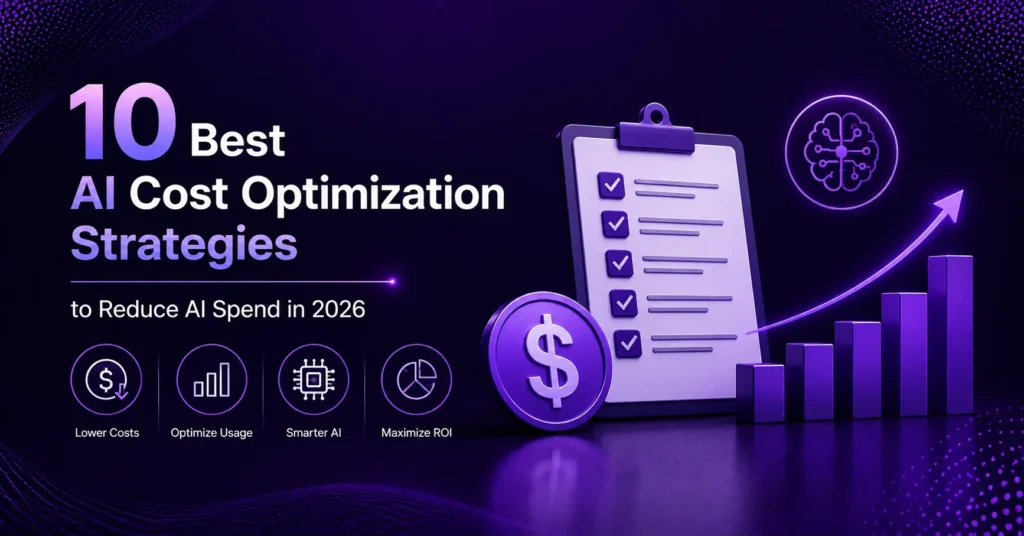
TL;DR: AI cost optimization means reducing what you spend on AI tools, models, and infrastructure without hurting performance. The best strategies include auditing licenses, choosing the right AI model per task, optimizing prompts, implementing governance, and tracking ROI continuously. Organizations that apply these strategies systematically can reduce AI spend by 70% or more.
AI investments are growing fast. So are the bills.
Organizations today pay for Microsoft Copilot licenses, ChatGPT Enterprise, Claude, AI agents, cloud GPUs, API usage, and automation platforms—often all at once. Without a clear strategy, AI costs can spiral well beyond the value they deliver.
According to a Gartner survey of over 300 CIOs, more than 90% said managing cost limits their ability to get value from AI. That’s not a technology problem. It’s a strategy problem.
The goal isn’t to spend less on AI. It’s to spend smarter. This post covers 10 practical AI cost optimization strategies to help you do exactly that.
What Is AI Cost Optimization?
AI cost optimization means reducing the Total Cost of AI Ownership while maintaining or improving performance, productivity, and business outcomes.
The major cost categories include:
- AI licenses (Microsoft Copilot, ChatGPT Enterprise, etc.)
- LLM API usage (paying per token or request)
- Cloud infrastructure (GPUs, compute, storage)
- AI agents and automation platforms
- Training and fine-tuning costs
- Support and governance overhead
Optimization doesn’t mean cutting corners. It means eliminating waste and making every dollar work harder.
Why Do AI Costs Spiral Out of Control?
Most AI overspending comes from predictable patterns:
- Paying for unused licenses and tools
- Using premium models for every task—even simple ones
- Shadow AI (employees using unapproved tools)
- Poor prompt design that wastes tokens
- Duplicate platforms doing the same job
- No governance or budget ownership
- Low adoption generating no ROI
The fix isn’t always obvious. That’s why a structured approach matters.
The AI Cost Optimization Framework: Discover → Measure → Optimize → Govern → Monitor
Before jumping into strategies, it helps to have a framework:
- Discover: Identify every AI tool and cost in your organization
- Measure: Understand usage, adoption, and cost per outcome
- Optimize: Apply targeted strategies to reduce waste
- Govern: Set policies, ownership, and controls
- Monitor: Track results and adjust continuously
Now, here are the 10 best strategies to apply within that framework.
10 Best AI Cost Optimization Strategies
Strategy 1: Audit Every AI Tool and License
Many organizations pay for AI tools their employees rarely use. A quarterly AI inventory is the fastest way to find waste.
What to review:
- Microsoft Copilot license utilization
- ChatGPT Enterprise and Claude seats
- SaaS tools with embedded AI features
- Inactive or duplicate user accounts
Business impact: Removing unused licenses often delivers immediate cost savings with zero impact on productivity.
Strategy 2: Choose the Right AI Model for Every Task
Not every task needs the most expensive model. This is one of the highest-ROI strategies available.
According to research from Stanford’s FrugalGPT project, intelligent model routing can achieve 50–98% cost reduction while matching or exceeding GPT-4 accuracy.
| Model Tier | Examples | Best Use Case |
|---|---|---|
| Premium Reasoning | o1, Claude Opus 4.5 | Complex analysis, research |
| Flagship | GPT-4o, Claude Sonnet | General enterprise tasks |
| Efficient | GPT-4o-mini, Gemini Flash | High-volume processing |
| Open Source | Llama 4, DeepSeek-V3 | Cost-sensitive workloads |
Simple rule: Use cheaper models for classification, summarization, and FAQs. Save premium models for complex reasoning.
Strategy 3: Optimize Prompts to Reduce Token Costs
Every word in a prompt costs money. Poorly written prompts waste tokens and increase API bills.
Better prompts:
- Reduce input and output tokens
- Improve accuracy (fewer retries)
- Lower API costs at scale
Practical steps:
- Build reusable prompt templates per use case
- Set explicit output formats and length limits
- Remove unnecessary context and examples
Microsoft Research’s LLMLingua tool achieves up to 20x prompt compression with less than 1.5% accuracy loss—a compelling example of what’s possible at scale.
Strategy 4: Optimize Microsoft Copilot Licensing
Microsoft Copilot is one of the largest AI line items for enterprise organizations. Without proper management, it’s also one of the easiest to overspend on.
How to optimize:
- Assign licenses only to roles with clear use cases
- Monitor adoption using the Microsoft 365 Admin Center
- Remove licenses for inactive users within 30 days
- Run phased department rollouts before scaling
- Track ROI by department and role
Organizations that actively manage Copilot adoption consistently see higher returns and lower per-user costs.
Strategy 5: Build AI Governance
Governance reduces duplicate tools, security risks, and budget overruns. Without it, departments buy overlapping AI platforms independently—and spend multiplies.
Key governance actions:
- Create an approved AI vendor list
- Require budget sign-off for new AI tools
- Define responsible AI usage policies
- Assign cost ownership to department leaders
As the FinOps Foundation defines it, FinOps is “an operational framework and cultural practice which maximizes the business value of technology… through collaboration between engineering, finance, and business teams.” The same principle applies directly to AI governance.
Strategy 6: Consolidate AI Platforms
Many organizations run ChatGPT, Claude, Gemini, and Copilot simultaneously—often for the same tasks.
Consolidation makes sense when:
- Multiple tools serve overlapping use cases
- Teams are too small to benefit from specialization
- Vendor management complexity outweighs flexibility
Consolidation may not make sense when different tools genuinely serve different workloads (e.g., Copilot for Microsoft 365 productivity vs. a specialized coding assistant).
Evaluate before you consolidate. The goal is fewer redundant tools, not fewer capable ones.
Strategy 7: Optimize AI Agents
AI agents can be powerful—and expensive. Poorly designed agents run unnecessary loops, call premium models repeatedly, and consume far more compute than needed.
How to reduce agent costs:
- Decompose tasks so simpler steps use cheaper models
- Set strict limits on agent iterations and retries
- Cache repeated lookups and retrievals
- Monitor cost per workflow, not just cost per run
According to Azilen Technologies, most AI spend in production comes from model usage, GPU utilization, and inefficient workflows—not model quality itself.
Strategy 8: Improve Employee Adoption
An unused AI license generates no business value. Low adoption is one of the most overlooked cost problems.
How to drive adoption:
- Run department-specific training sessions
- Appoint AI champions within each team
- Share prompt libraries and use-case playbooks
- Celebrate and communicate quick wins internally
Higher adoption turns a sunk cost into a genuine productivity investment.
Strategy 9: Implement AI FinOps
AI FinOps brings together Finance, IT, Engineering, and Business to manage AI spend collectively. It creates accountability and prevents budget surprises.
Core AI FinOps practices:
- Allocate costs by team, department, or workflow
- Assign clear budget ownership
- Implement chargeback or showback models
- Build executive-level dashboards for spend visibility
- Forecast usage and budget quarterly
This isn’t just an IT concern. When finance and business leaders see AI costs attributed to their teams, spending decisions become sharper.
Strategy 10: Continuously Measure AI ROI
Optimization is not a one-time exercise. It requires ongoing measurement.
Key metrics to track:
- Cost per employee using AI
- Cost per workflow or task type
- AI adoption rate by department
- Time saved vs. baseline
- Active vs. assigned licenses
- Business outcomes tied to AI usage
Organizations that measure AI ROI consistently make better investment decisions—and find new opportunities to reduce waste over time.
AI Cost Optimization by Business Size
| Business Size | Biggest Cost Challenge | Best Starting Strategy |
|---|---|---|
| Startup | Tool sprawl | Platform consolidation |
| SMB | Low adoption | Training and enablement |
| Mid-Market | License waste | Governance and audit |
| Enterprise | Infrastructure cost | AI FinOps |
AI Cost Optimization by Department
| Department | Biggest AI Cost | Optimization Opportunity |
|---|---|---|
| HR | Recruiting platform licenses | Consolidate to one tool |
| Sales | CRM AI add-ons | Audit active users |
| Marketing | Content generation APIs | Prompt optimization |
| Finance | Reporting and analytics tools | Batch processing |
| IT | Infrastructure and GPU usage | Autoscaling and right-sizing |
| Operations | Automation agents | Agent workflow optimization |
| Customer Support | Chatbot API usage | Caching and model routing |
Common AI Cost Optimization Mistakes
❌ Buying more licenses than you currently need
❌ Using premium AI models for every task, including simple ones
❌ Skipping governance until costs are already out of control
❌ Not monitoring usage or adoption
❌ Writing verbose, inefficient prompts
❌ Running multiple overlapping AI vendors without review
❌ Ignoring employee training and adoption
❌ Never measuring actual ROI
AI Cost Optimization Checklist
Use this checklist to get started:
- ✔ Complete an AI tool inventory
- ✔ Run a license utilization audit
- ✔ Review model usage and right-size where possible
- ✔ Implement prompt templates and guidelines
- ✔ Establish an AI governance policy
- ✔ Assign budget ownership by team
- ✔ Set up a cost visibility dashboard
- ✔ Define KPIs and ROI metrics
- ✔ Schedule a quarterly review process
What Tools Help Monitor and Optimize AI Costs?
You don’t need to manage AI spending manually. These tool categories can help:
- AI Spend Monitoring: Microsoft Admin Center, Azure Cost Management
- LLM Observability: LiteLLM, Helicone, Portkey
- Cloud FinOps Platforms: Sedai, CloudKeeper
- Usage Analytics: Built-in dashboards in OpenAI, Anthropic, and Google portals
Choose tools based on where your highest costs sit—cloud infrastructure, API usage, or SaaS licensing.
Stop Paying for AI You’re Not Getting Value From
Successful organizations don’t reduce AI costs by slowing down innovation. They reduce costs by being smarter about how they deploy, govern, and measure AI.
The 10 strategies above—starting with an audit and ending with continuous ROI measurement—give you a clear path from reactive spending to intentional investment.
👉 Book a Free AI Cost Optimization Assessment
Frequently Asked Questions
What is AI cost optimization?
AI cost optimization is the practice of reducing what an organization spends on AI tools, models, infrastructure, and licenses—without sacrificing performance or productivity. It covers everything from LLM API usage to SaaS licensing and cloud GPU costs.
What are the best AI cost optimization strategies in 2026?
The most impactful strategies are: auditing AI licenses, choosing the right model for each task, optimizing prompts, implementing AI governance, consolidating platforms, improving employee adoption, and applying AI FinOps practices.
How can companies reduce AI costs without cutting capabilities?
By matching AI models to task complexity, eliminating unused licenses, caching repeated queries, and building governance frameworks. According to research cited by AIPricingMaster, combining prompt caching, model routing, and batch processing can achieve 70–85% cost reduction in production environments.
What is AI FinOps?
AI FinOps applies financial operations principles to AI spending. It brings together engineering, finance, and business teams to create cost visibility, assign budget ownership, and make data-driven decisions about AI investment. The FinOps Foundation defines FinOps as a framework that “maximizes the business value of technology… through collaboration between engineering, finance, and business teams.”
How do I optimize Microsoft Copilot licensing?
Assign licenses based on role and use case, monitor adoption through the Microsoft 365 Admin Center, remove inactive users, and run phased rollouts by department. Track ROI per team to justify ongoing spend.
How do AI agents increase costs?
AI agents can call expensive models repeatedly, run unnecessary loops, and consume significant compute without proper design. Decomposing tasks, setting iteration limits, and using cheaper models for simpler steps can significantly reduce agent-related costs.
What is the biggest AI cost driver for most organizations?
Unused licenses and over-reliance on premium models are two of the largest drivers of avoidable AI spend. Poor prompt design and lack of governance amplify both problems over time.
How often should AI spending be reviewed?
At minimum, quarterly. High-volume AI deployments benefit from monthly reviews. Set up real-time dashboards so anomalies—like unexpected API spikes—are caught immediately, not weeks later.
How do I calculate AI ROI?
Track cost per employee, cost per workflow, time saved versus a pre-AI baseline, and adoption rates. Compare these against the fully loaded cost of AI tools, licenses, and infrastructure. ROI improves significantly when adoption is high and models are right-sized.
Can small businesses benefit from AI cost optimization?
Yes. Small businesses are often most exposed to tool sprawl and unused licenses. Even basic steps—like auditing tools and removing inactive seats—can deliver immediate savings with minimal effort.
What is the first step to building an AI governance strategy?
Start by inventorying every AI tool in use across the organization. From there, define which tools are approved, assign budget ownership, and set a policy for how new AI purchases must be evaluated and approved before deployment.
